Wednesday, April 14, 2010

"the Raven" by Edgar Allan Poe.


Whether you are a lunatic, geek,poet or philosopher ,you will assuredly love for the rest of your life this unusual poem of indescribable beauty. The raven  is a much loved poem which ranks at the top  of my favorites poems list of all time. i would even say that apart from Alfred lord Tennyson's  Ulysses, the raven is my deary poem.It posses an odd feeling of darkness ( which Poe's paints in the reader mind trough vivid verbal depictions of the raven, this mysterious bird), obsession  and profound lunacy. I used to have a dog that spoke "human words" sometimes ( at least in my illusions);I suppose, that is one of the reasons that i personalty like Poe's the raven so much.


                     The Raven 
                           By Edgar Allan Poe.


Once upon a midnight dreary, while I pondered weak and weary,
Over many a quaint and curious volume of forgotten lore,
While I nodded, nearly napping, suddenly there came a tapping,
As of some one gently rapping, rapping at my chamber door.
`'Tis some visitor,' I muttered, `tapping at my chamber door -
Only this, and nothing more.'

Ah, distinctly I remember it was in the bleak December,
And each separate dying ember wrought its ghost upon the floor.
Eagerly I wished the morrow; - vainly I had sought to borrow
From my books surcease of sorrow - sorrow for the lost Lenore -
For the rare and radiant maiden whom the angels named Lenore -
Nameless here for evermore.

And the silken sad uncertain rustling of each purple curtain
Thrilled me - filled me with fantastic terrors never felt before;
So that now, to still the beating of my heart, I stood repeating
`'Tis some visitor entreating entrance at my chamber door -
Some late visitor entreating entrance at my chamber door; -
This it is, and nothing more,'

Presently my soul grew stronger; hesitating then no longer,
`Sir,' said I, `or Madam, truly your forgiveness I implore;
But the fact is I was napping, and so gently you came rapping,
And so faintly you came tapping, tapping at my chamber door,
That I scarce was sure I heard you' - here I opened wide the door; -
Darkness there, and nothing more.

Deep into that darkness peering, long I stood there wondering, fearing,
Doubting, dreaming dreams no mortal ever dared to dream before
But the silence was unbroken, and the darkness gave no token,
And the only word there spoken was the whispered word, `Lenore!'
This I whispered, and an echo murmured back the word, `Lenore!'
Merely this and nothing more.

Back into the chamber turning, all my soul within me burning,
Soon again I heard a tapping somewhat louder than before.
`Surely,' said I, `surely that is something at my window lattice;
Let me see then, what thereat is, and this mystery explore -
Let my heart be still a moment and this mystery explore; -
'Tis the wind and nothing more!'

Open here I flung the shutter, when, with many a flirt and flutter,
In there stepped a stately raven of the saintly days of yore.
Not the least obeisance made he; not a minute stopped or stayed he;
But, with mien of lord or lady, perched above my chamber door -
Perched upon a bust of Pallas just above my chamber door -
Perched, and sat, and nothing more.

Then this ebony bird beguiling my sad fancy into smiling,
By the grave and stern decorum of the countenance it wore,
`Though thy crest be shorn and shaven, thou,' I said, `art sure no craven.
Ghastly grim and ancient raven wandering from the nightly shore -
Tell me what thy lordly name is on the Night's Plutonian shore!'
Quoth the raven, `Nevermore.'

Much I marvelled this ungainly fowl to hear discourse so plainly,
Though its answer little meaning - little relevancy bore;
For we cannot help agreeing that no living human being
Ever yet was blessed with seeing bird above his chamber door -
Bird or beast above the sculptured bust above his chamber door,
With such name as `Nevermore.'

But the raven, sitting lonely on the placid bust, spoke only,
That one word, as if his soul in that one word he did outpour.
Nothing further then he uttered - not a feather then he fluttered -
Till I scarcely more than muttered `Other friends have flown before -
On the morrow he will leave me, as my hopes have flown before.'
Then the bird said, `Nevermore.'

Startled at the stillness broken by reply so aptly spoken,
`Doubtless,' said I, `what it utters is its only stock and store,
Caught from some unhappy master whom unmerciful disaster
Followed fast and followed faster till his songs one burden bore -
Till the dirges of his hope that melancholy burden bore
Of "Never-nevermore."'

But the raven still beguiling all my sad soul into smiling,
Straight I wheeled a cushioned seat in front of bird and bust and door;
Then, upon the velvet sinking, I betook myself to linking
Fancy unto fancy, thinking what this ominous bird of yore -
What this grim, ungainly, ghastly, gaunt, and ominous bird of yore
Meant in croaking `Nevermore.'

This I sat engaged in guessing, but no syllable expressing
To the fowl whose fiery eyes now burned into my bosom's core;
This and more I sat divining, with my head at ease reclining
On the cushion's velvet lining that the lamp-light gloated o'er,
But whose velvet violet lining with the lamp-light gloating o'er,
She shall press, ah, nevermore!

Then, methought, the air grew denser, perfumed from an unseen censer
Swung by Seraphim whose foot-falls tinkled on the tufted floor.
`Wretch,' I cried, `thy God hath lent thee - by these angels he has sent thee
Respite - respite and nepenthe from thy memories of Lenore!
Quaff, oh quaff this kind nepenthe, and forget this lost Lenore!'
Quoth the raven, `Nevermore.'

`Prophet!' said I, `thing of evil! - prophet still, if bird or devil! -
Whether tempter sent, or whether tempest tossed thee here ashore,
Desolate yet all undaunted, on this desert land enchanted -
On this home by horror haunted - tell me truly, I implore -
Is there - is there balm in Gilead? - tell me - tell me, I implore!'
Quoth the raven, `Nevermore.'

`Prophet!' said I, `thing of evil! - prophet still, if bird or devil!
By that Heaven that bends above us - by that God we both adore -
Tell this soul with sorrow laden if, within the distant Aidenn,
It shall clasp a sainted maiden whom the angels named Lenore -
Clasp a rare and radiant maiden, whom the angels named Lenore?'
Quoth the raven, `Nevermore.'

`Be that word our sign of parting, bird or fiend!' I shrieked upstarting -
`Get thee back into the tempest and the Night's Plutonian shore!
Leave no black plume as a token of that lie thy soul hath spoken!
Leave my loneliness unbroken! - quit the bust above my door!
Take thy beak from out my heart, and take thy form from off my door!'
Quoth the raven, `Nevermore.'

And the raven, never flitting, still is sitting, still is sitting
On the pallid bust of Pallas just above my chamber door;
And his eyes have all the seeming of a demon's that is dreaming,
And the lamp-light o'er him streaming throws his shadow on the floor;
And my soul from out that shadow that lies floating on the floor
Shall be lifted - nevermore!

Share/Bookmark

Thursday, April 8, 2010

The Fool

By Mory Keita

There was a fool, there was a sage,
There was a king, there was a peasant,
There was a charlatan, there was a scholar,
All in quest of glories to come;
Amongst them the fool was the most hated.
He once stood upon Mont Sinai, God’s stick in hand
And prophesied to his people the moon landing,
But he was ridiculed.
He traveled nations like Moses, declaring that all men are equal,
But he was mocked and threatened by kings and aristocrats.
Again, he studied heavens days and nights,
Then proclaimed in all truth that earth was round,
But he was accused of heresy. 
Upon all times was a fool, upon all times was a detractor.
But fools prevailed as the world evolved.
Thus, I have decided to travel the road of the fool.

Share/Bookmark

Thursday, March 11, 2010

Edgard Alan Poe --- Annabel Lee

well, as one of my friends pointed out, this is the kind of poem to charm a lady's heart. lol. i  truly love this poem. it makes me laugh, think , meditate and appreciate my life. All hail  Mr. Edgard Alan Poe. Annabel lee is also the last poem composed by Poe and it was published few months after his death.


It was many and many a year ago,
In a kingdom by the sea,
That a maiden there lived whom you may know
By the name of ANNABEL LEE;
And this maiden she lived with no other thought
Than to love and be loved by me.

I was a child and she was a child,
In this kingdom by the sea;
But we loved with a love that was more than love-
I and my Annabel Lee;
With a love that the winged seraphs of heaven
Coveted her and me.

And this was the reason that, long ago,
In this kingdom by the sea,
A wind blew out of a cloud, chilling
My beautiful Annabel Lee;
So that her highborn kinsman came
And bore her away from me,
To shut her up in a sepulchre
In this kingdom by the sea.

The angels, not half so happy in heaven,
Went envying her and me-
Yes!- that was the reason (as all men know,
In this kingdom by the sea)
That the wind came out of the cloud by night,
Chilling and killing my Annabel Lee.

But our love it was stronger by far than the love
Of those who were older than we-
Of many far wiser than we-
And neither the angels in heaven above,
Nor the demons down under the sea,
Can ever dissever my soul from the soul
Of the beautiful Annabel Lee.

For the moon never beams without bringing me dreams
Of the beautiful Annabel Lee;
And the stars never rise but I feel the bright eyes
Of the beautiful Annabel Lee;
And so, all the night-tide, I lie down by the side
Of my darling- my darling- my life and my bride,
In the sepulchre there by the sea,
In her tomb by the sounding sea.
Share/Bookmark

Wednesday, March 10, 2010

John Donne : The Sun rising.


  "The Sun Rising" is truly magnificent-- i have red very few poems with such vivid imagery and "perfect" metaphors. as i often say, great poets have big-open hearts and  profound imagination. i can write an entire post on this poem, but i realize that it would be useless. so,let " The Sun Rising" speak for itself and its radiance blossom our creativity; for,la passion est la porte a l'imagination créative.


 BUSY old fool, unruly Sun,
        Why dost thou thus,
Through windows, and through curtains, call on us ?
Must to thy motions lovers' seasons run ?
        Saucy pedantic wretch, go chide
        Late school-boys and sour prentices,
    Go tell court-huntsmen that the king will ride,
    Call country ants to harvest offices ;
Love, all alike, no season knows nor clime,
Nor hours, days, months, which are the rags of time.

        Thy beams so reverend, and strong
        Why shouldst thou think ?
I could eclipse and cloud them with a wink,
But that I would not lose her sight so long.
        If her eyes have not blinded thine,
        Look, and to-morrow late tell me,
    Whether both th' Indias of spice and mine
    Be where thou left'st them, or lie here with me.
Ask for those kings whom thou saw'st yesterday,
And thou shalt hear, "All here in one bed lay."

        She's all states, and all princes I ;
        Nothing else is ;
Princes do but play us ; compared to this,
All honour's mimic, all wealth alchemy.
        Thou, Sun, art half as happy as we,
        In that the world's contracted thus ;
    Thine age asks ease, and since thy duties be
    To warm the world, that's done in warming us.
Shine here to us, and thou art everywhere ;
This bed thy center is, these walls thy sphere.
Share/Bookmark

Friday, February 26, 2010

How did Nikola Tesla change the way we use energy?


Today, 02/26/10, while reading a new article from my favorite website HowStuffWorks, I found this fascinating article titled: How did Nikola Tesla changed the way we use energy?.As a Tesla fan, i was instantly  pulled to read  the article and  fully explore its content.

Thus begin the article, " When you flip a switch and a lamp bathes the room in light, you probably don't give much thought to how it works -- or to the people who made it all possible. If you were forced to acknowledge the genius behind the lamp, you might name Thomas Alva Edison." I must admit that I too  thought, for a  long time, that Thomas Edison was probably the greatest inventor of all time, I thought he invented the light bulb, the AC motor and others, until I unexpectedly  stumbled upon a youtube video with the title Nikola Tesla: The Forgotten Wizard. The only forgotten genius (Wizard)  that i knew of  at that time was Robert Hook, whose ground breaking scientific works were undermined by Newton's achievements. 

Tesla's achievements are generally unknown of by the general public. ask a middle school student or high schools student and even High school teacher who invented the Radio, he/she will quickly respond Marconi;  wireless communication, he/she would reply that he/she does not know or maybe guess Edison. It is not astonishing to hear such answers ( i bet more than 95 % of the readers of this blog would have given similar answers).What make me mad, brain-sick is that the incredible legacy of a man who sacrificed his life, refused financial gains  for the advancement of science and technology, are being accredited to others. while I do not denied that both Marconi and Edison made significant contributions to science, I believe that it is immoral for schools to teach  students that they ( Edison and Marconi) achieved things that they did not. in fact, just after Tesla's death the united state supreme court ruled that Nikola Tesla indeed was the true inventor of the radio and wireless communication. Tesla also is the inventor of remote control, basic lasers, star war technical warfare , robotics and others.

In response to the question, How did Nikola Tesla change the way we use energy? I would simply reply that he invented and found new ways release gigantic amount of pure and clean energy at lesser cost for our environment and us.

To read  more about Tesla please click  here and here.
Share/Bookmark

Wednesday, January 27, 2010

William Butler Yeats - The Second Coming

Whenever i read this majestic poem of William Butler Yeats,tears come  to my eyes.To me, the Second Coming is the manifestation of horrors to come,human cruelty and most importantly the danger of power and greed.The apocalyptic nature of Yeats' the second coming is a reminder to every well-thinking mind.


                  The Second Coming


Turning and turning in the widening gyre
The falcon cannot hear the falconer;
Things fall apart; the centre cannot hold;
Mere anarchy is loosed upon the world,
The blood-dimmed tide is loosed, and everywhere
The ceremony of innocence is drowned;
The best lack all conviction, while the worst
Are full of passionate intensity.
Surely some revelation is at hand;
Surely the Second Coming is at hand.
The Second Coming! Hardly are those words out
When a vast image out of Spritus Mundi
Troubles my sight: somewhere in the sands of the desert
A shape with lion body and the head of a man,
A gaze blank and pitiless as the sun,
Is moving its slow thighs, while all about it
Reel shadows of the indignant desert birds.
The darkness drops again; but now I know
That twenty centuries of stony sleep
were vexed to nightmare by a rocking cradle,
And what rough beast, its hour come round at last,
Slouches towards Bethlehem to be born?


Note: if you are interested in learning more about William Butler Yeats, please click on here. To read an interpretation of the second coming , click on here.


Share/Bookmark

Thursday, January 21, 2010

Ulysses by Alfred,Lord Tennyson

    Ulysses is most certainly   my favorite poem. I hope you will enjoy it.            


Ulysses     


It little profits that an idle king,
By this still hearth, among these barren crags,
Matched with an aged wife, I mete and dole
Unequal laws unto a savage race,
That hoard, and sleep, and feed, and know not me.

I cannot rest from travel: I will drink
Life to the lees: all times I have enjoyed
Greatly, have suffered greatly, both with those
That loved me, and alone; on shore, and when
Through scudding drifts the rainy Hyades
Vest the dim sea: I am become a name;
For always roaming with a hungry heart
Much have I seen and known; cities of men
And manners, climates, councils, governments,
Myself not least, but honoured of them all;
And drunk delight of battle with my peers;
Far on the ringing plains of windy Troy.
I am part of all that I have met;
Yet all experience is an arch wherethrough
Gleams that untravelled world, whose margin fades
For ever and for ever when I move.
How dull it is to pause, to make an end,
To rust unburnished, not to shine in use!
As though to breath were life. Life piled on life
Were all to little, and of one to me
Little remains: but every hour is saved
From that eternal silence, something more,
A bringer of new things; and vile it were
For some three suns to store and hoard myself,
And this gray spirit yearning in desire
To follow knowledge like a sinking star,
Beyond the utmost bound of human thought.

This is my son, mine own Telemachus,
To whom I leave the scepter and the isle
Well-loved of me, discerning to fulfill
This labour, by slow prudence to make mild
A rugged people, and through soft degrees
Subdue them to the useful and the good.
Most blameless is he, centered in the sphere
Of common duties, decent not to fail
In offices of tenderness, and pay
Meet adoration to my household gods,
When I am gone. He works his work, I mine.

There lies the port; the vessel puffs her sail:
There gloom the dark broad seas. My mariners,
Souls that have toiled, and wrought, and thought with me
That ever with a frolic welcome took
The thunder and the sunshine, and opposed
Free hearts, free foreheads you and I are old;
Old age had yet his honour and his toil;
Death closes all: but something ere the end,
Some work of noble note, may yet be done,
Not unbecoming men that strove with Gods.
The lights begin to twinkle from the rocks:
The long day wanes: the slow moon climbs: the deep
Moans round with many voices. Come, my friends,
'Tis not too late to seek a newer world.
Push off, and sitting well in order smite
The sounding furrows; for my purpose holds
To sail beyond the sunset, and the baths
Of all the western stars, until I die.
It may be that the gulfs will wash us down:
It may be we shall touch the Happy Isles,
And see the great Achilles, whom we knew.
Though much is taken, much abides; and though
We are not now that strength which in the old days
Moved earth and heaven; that which we are, we are,
One equal-temper of heroic hearts,
Made weak by time and fate, but strong in will
To strive, to seek, to find, and not to yield.

Share/Bookmark

Sunday, January 10, 2010

The Madman is amongst us

             At four o’clock of the night, he woke up and managed to get out of his bed. Wearing a dark jacket, eyes covered by lunettes, he turned on light, took a deep breath and ghostly marched towards the door to wait for his victim. “The Madman,” those who saw him secretly whispered to each others, “where the hell is he going this early?”
            During the two or three years that he has lived in his isolated apartment, no living soul has seen his face or heard his voice. It is said that the few unfortunates who saw his monstrous eyes perished immediately. He never went out at daylight or spoke to his suspicious, foolish neighbors. There were rumors circulating that he was a spooky vampire or some kind of Greek mythological creatures called “Minotaur”. If you ask the neighborhood children about him, they will certainly say that he is a murdered hiding from the police.
           Behold! Curiosity took over me. In a cold icy day, I courageously took the resolution to uncover the identity of the person hiding behind this mysterious character. I woke up early to meet his habitual stairway descent time. He was wearing the same shit (cloths) as usual. As he walked down in the deserted streets, I followed him steps by steps with a snake-like attentiveness. After nearly thirty five minutes of endless march, he turned his back and carefully analyzed his surrounding; “Bump, bump!” I hear my heart bits - I felt like facing an imminent danger.
          At the corner of a street, he stopped and suddenly began taking his lunettes and jacket off. As I carefully observe him, a familiar silhouette distinguished itself: tall, white male, shaggy looking. PE-DER-SEN, I proclaimed loudly with an air of astonishment. I think he heard my voice and saw me running across the streets because his face was firing like a boiling volcano waiting to erupt. After making this astonishing, yet marvelous discovery, I ran to school heart pounding afraid.
                                   Do not stare at me, he is the madman not me.  
           While passing by his class room, I saw his devilish face uncovered; he was smiling like an angel to some of his students. He did not look like the mysterious madman who has inspired hundreds of myths. But, I did not let his angelical new appearance deceive me; for, the devil itself, Lady Macbeth, advised her treacherous husband in Shakespeare’s Macbeth “look like the innocent flower, but be the serpent under it”.
 Beware the devil is double-faced.
                                 
              I didn’t want to go into his class, but Mr. Noonan forced me to. I tried to briefly explain to him the true nature of the man hiding behind our Mr. Pedersen, but his ears were blind.  “Kids” he said with mockery “always trying to find excuses not to go to class”.  When I entered the room, he stared at me like a ferocious bull preparing to attack.
“Mory sit here,” he said calmly.
“Sirrrr,” I replied nervously “I would prefer to sit on the back”.
“No, no, the front must be filled first”.
           
While speaking I observed his facial expression. He laughed. He laughed and laughed again with the evil smile on his face.
            
Take ten minutes to write a short poem describing you” he addressed the class emphasizing the verb “to describe”. “Describe myself” I whispered, “why doesn’t he describe himself?” . Later on I figured it out that he wanted us to reveal or weakness’ and take advantage of them. Didn’t you see him smiling like a viper?
          
The bell rang a while after and we were dismissed from his class. While leaving his class, he called upon me and manifested his true nature. He was a bizarre creature …. Very bizarre...very, his has a rectangular face, big noose, eyes of varied sizes and a large disgusting mouth. Do you want to discover who he is? Well, he is an alien enveloped in an artificial human body. I know it because….. No, it is a secret, ask him yourself.
           
Since that day, the madman hunts me in my nightmares; I think that I’m his next victim. He once pointed at my face and said “you are the next”. Help, save me! Save me from the madman and his extraterrestrial insanity. Do not approach him. Do not let him deceive you with his smile, for the devil is a smile.

Note: This is just a piece of fiction; therefore any description presented in this piece is purely fictional.  


Mr.Petersen: my high school creative writing teacher.
Mr.Noonan: high school principal.
The school: High School for Arts , Imagination and Inquiry.

Share/Bookmark

Wednesday, January 6, 2010

I,Mory,Thor


He firmly stood atop a giant skyscraper in downtown New York, observing the streets, contemplating the empire of “peace" he has created. An empire ruled by him, king of kings, Monarch of monarchs, Caliphs of caliphs, and God of gods- him the Punisher. As he walked down the crowded street, his name was constantly hailed by ignorants, fearfuls simpletons “All hail the Punisher, we are thy humble servants." He glorified himself for bringing chaos which he called peace along with his demonic steps; He named dictatorship - democracy, and the world - his eternal kingdom. To represent his supremacy over the City, he replaced the head of the status of liberty with his own and placed his giant status atop the Empire State building.

But behold! His reign of terror was to come to its end when I,Mory,Thor, god of thunder rebelled against him.
I went to his celestial palace one early morning, defeated his guards with my godly fury. Then, I shouted at him “Give up, the punisher. Your reign of terror is over".
" Terror?" he replied mockingly “I bring peace to this world and the people like me."
"Come out of your cage, fight me coward if thou are deserving of thy name." I furiously yelled at him.
" Prepare to confront my fury" he instantly replied.

He suddenly threw his smelly body upon me and we began fighting. After endless hours of intense fighting, I finally smacked him with my mighty hammer and thunder stroke him. He perished like a vulture.  With rebellious bravery, I brought real "peace" to the world and vanquish for ever chaos.
Since that memorable event that defined the faith of mankind, humans are still hailing my name “All hail Mory,Thor, our Savior."
 Note: This is piece of writing is purely fictional.To learn more about  Thor,encourage you to click here to read the Wikipedia article.
Share/Bookmark

Sunday, January 3, 2010

Simply Brillant : Ingenious Archimedes


In 214 BC, a powerful Roman force attacked the city of Syracuse, the home of the famed mathematician and inventor Archimedes. To hold off the Roman legions, he devised one ingenious weapon after another, among them a catapult which could hurl a ton of stones some six hundred feet.


His most remarkable contraption, however, was brilliant in its sheer simplicity: Using an array of mirrors, Archimedes directed and concentrated the sun's rays onto the Roman ships and set them ablaze.


Creditanecdotage.com


PLUS“Give me a lever long enough and a fulcrum on which to place it, and I shall move the world.”  said Archimedes.


to learn more about Archimedes click here to read his biography on Wikipedia.
Share/Bookmark

Charles Baudelaire "Le Mort joyeux"


here is, what i consider as, the masterpiece of the great French poet Charles Baudelaire. le mort joyeux ( the happy dead), is, though somehow cynical, the most reflective poem i have red. i remember reciting it once in class, when i was about 9 years old in my country. every french speaking person, i believe, will agree that that le mort joyeux is unique in its own way.

Dans une terre grasse et pleine d'escargots
Je veux creuser moi-même une fosse profonde,
Où je puisse à loisir étaler mes vieux os
Et dormir dans l'oubli comme un requin dans l'onde.
Je hais les testaments et je hais les tombeaux;
Plutôt que d'implorer une larme du monde,
Vivant, j'aimerais mieux inviter les corbeaux
À saigner tous les bouts de ma carcasse immonde.
Ô vers! noirs compagnons sans oreille et sans yeux,
Voyez venir à vous un mort libre et joyeux;
Philosophes viveurs, fils de la pourriture,
À travers ma ruine allez donc sans remords,
Et dites-moi s'il est encore quelque torture
Pour ce vieux corps sans âme et mort parmi les morts!

Share/Bookmark

Thursday, November 19, 2009

scientists


science becomes a profession:

"It is natural to describe key [scientific] events in terms of the work of individuals who made a mark in science - Copernicus, Vesalius, Darwin, Wallace and the rest. But this does not mean that science has progressed as a result of the work of a string of irreplaceable geniuses possessed of a special insight into how the world works. Geniuses maybe (though not always); but irreplaceable certainly not. Scientific progress builds step by step, and as the example of Charles Darwin and Alfred Russel Wallace [who independently and simultaneously put forward the theory of evolution] shows, when the time is ripe, two or more individuals may make the next step independently of one another. It is the luck of the draw, or historical accident, whose name gets remembered as the discoverer of a new phenomenon.

"What is much more important than human genius is the development of technology, and it is no surprise that the start of the scientific revolution 'coincides' with the development of the telescope and the microscope. ... If Newton had never lived, scientific progress might have been held back by a few decades. But only by a few decades. Edmond Halley or Robert Hooke might well have come up with the famous inverse square law of gravity; Gottfried Leibniz actually did invent calculus independently of Newton (and made a better job of it); and Christiaan Huygens's superior wave theory of light was held back by Newton's espousal of the rival particle theory. ...

"Although the figure of Charles Darwin dominates any discussion of nineteenth-century science, he is something of an anomaly. It is during the nineteenth century - almost exactly during Darwin's lifetime - that science makes the shift from being a gentlemanly hobby, where the interests and abilities of a single individual can have a profound impact, to a well-populated profession, where progress depends on the work of many individuals who are, to some extent, interchangeable. Even in the case of the theory of natural selection, as we have seen, if Darwin hadn't come up with the idea, Wallace would have, and from now on we will increasingly find that discoveries are made more or less simultaneously by different people working independently and largely in ignorance of one another. ...

"The other side of this particular coin, unfortunately, is that the growing number of scientists brings with it a growing inertia and resulting resistance to change, which means that all too often when some brilliant individual does come up with a profound new insight into the way the world works, this is not accepted immediately on merit and may take a generation to work its way into the collective received wisdom of science. ...

"In 1766, there were probably no more than 300 people who we would now class as scientists in the entire world. By 1800, ... there were about a thousand. By ... 1844, there were about 10,000, and by 1900 somewhere around 100,000. Roughly speaking, the number of scientists doubled every fifteen years during the nineteenth century. But remember that the whole population of Europe doubled, from about 100 million to about 200 million, between 1750 and 1850, and the population of Britain alone doubled between 1800 and 1850, from roughly 9 million to roughly 18 million."

John Gribbin, The Scientists, Random House, Copyright 2002 by John and Mary Gribbin, pp. xix-xx, 359-361.


Credit: delanceyplace.com


Share/Bookmark

Sunday, November 15, 2009

Why don't I talk a lot ?: The unreasonable unmasked.

Well, I have been called "Anti-social" in numerous instances  since my early childhood but for those who really know me, most will say that I am just shy. Am I shy ? maybe. I personally believe that my primary motive  for stranding myself from humans is just a question of philosophy - a natural philosophy. Most of us are busy with their look , falling in love, and finances instead of contemplating the majestic beauty of nature.

I have always been a philosopher, a nature lover; i guess that is the reason I am dedicating my life to sciences and mathematics. Above our heads are countless stars, parallel universes and even black holes. Isn't fascinating to see trough nature?

You may ask yourself , " is this guy reasonable ?" ; no , I am unreasonable  and do not seek to appear reasonable. I am a rebel. As the famous  English writer and philosopher,  Gorge Bernard Shaw famously  remarked said "the reasonable man adapts himself to the world; the unreasonable one persists in trying to adapt the world to himself. Therefore, all progress depends on the unreasonable man."Thus , let me be myself and let history follow is course.

Share/Bookmark

sir isaac newton


Sir Isaac Newton, whose masterwork Mathematical Principles of Natural History was one of the two or three most foundational and influential works in all of Western Science. This work had as its core his three laws of motion and his universal law of gravitation:

"Newton was a decidedly odd figure--brilliant beyond measure, but solitary, joyless, prickly to the point of paranoia, famously distracted (upon swinging his feet out of bed in the morning he would reportedly sometimes sit for hours, immobilized by the sudden rush of thoughts to his head), and capable of the most riveting strangeness. He built his own laboratory, the first at Cambridge, but then engaged in the most bizarre experiments. Once he inserted a bodkin--a long needle of the sort used for sewing leather--into his eye socket and rubbed it around 'betwixt my eye and the bone near to the backside of my eye as I could' just to see what would happen. What happened, miraculously, was nothing--at least nothing lasting. On another occasion, he stared at the sun for as long as he could bear, to determine what effect it would have upon his vision. Again he escaped lasting damage, though he had to spend some days in a darkened room before his eyes forgave him.

"Set atop these ... quirky traits, however, was the mind of a supreme genius. ... [As recounted by] Newton confidant, Abraham DeMoivre, 'In 1684 Dr. Edmond Halley [of Halley's comet fame] came to visit at Cambridge and after they had some time together the Doctor asked [Newton] what he thought the curve would be that would be described by the planets supposing the force of attraction toward the sun to be reciprocal to the square of their distance from it.' This was a reference to a piece of mathematics known as the inverse square law, which Halley was convinced lay at the heart of the explanation, though he wasn't sure exactly how. 'Sir Isaac replied immediately that it would be an ellipse. The Doctor, struck with joy and amazement, asked him how he knew it. 'Why,' saith he, 'I have calculated it,' whereupon Dr. Halley asked him for his calculation without further delay, Sir Isaac looked among his papers but could not find it.'

"This was astounding--like someone saying that he had found a cure for cancer but couldn't remember where he had put the formula. Pressed by Halley, Newton agreed to redo the calculations and produce a paper. He did as promised, but then did much more. He retired for two years of intensive reflection and scribbling, and at length produced his masterwork: the Philosophiae Naturalis Principia Mathematica or Mathematical Principles of Natural Philosophy, better known as the Principia."

Bill Bryson, A Short History of Nearly Everything, Broadway Books, Copyright 2003 by Bill Bryson, pp. 46-48.


credit: delancey place
Share/Bookmark

Saturday, November 14, 2009

lazy "dog" einstein


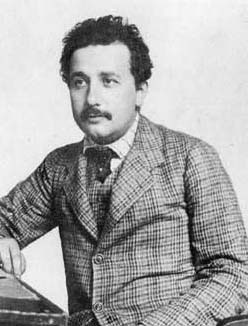
  young Albert Einstein:
"In the early 1900s, Einstein was a brilliant young scientist (26 in 1905) working independently of the usual academic community, who was obsessed with the idea of proving that atoms are real. [The existence of atoms was widely conjectured but not yet proven at this time.] ... This search was being carried out in the context of Einstein trying to obtain a PhD, which, by the beginning of the twentieth century was already being seen as the scientist's meal ticket, an essential requirement for anyone hoping to pursue a career in university research. Einstein had graduated from the Eidgenossische Technische Hochschule (ETH--the Swiss Federal Institute of Technology) in Zurich in 1900, but although he had done well in his final examinations, his attitude had not endeared him to the professors at the ETH (one of his tutors, Hermann Minkowski, described young Albert as a 'lazy dog' who 'never bothered about mathematics at all'), and he was unable to get a job as one of their assistants, and equally unable to get a decent reference from them for a junior academic post.

"So he had a variety of short-term and part-time jobs before becoming a patent officer in Bern in 1902. He spent a lot of time working on scientific problems (not just in his spare time, but also at his desk when he should have been working on patent applications) and published several papers between 1900 and 1905. But his most important project was to obtain that PhD and reopen the doors to academia. The ETH did not award doctorates itself, but there was an arrangement whereby graduates from the ETH could submit a doctoral thesis to the University of Zurich for approval, and this is the path Einstein took. After an abortive attempt on a piece of work which he decided in the end not to submit, he was ready in 1905 with a paper that would prove entirely satisfactory to the examiners in Zurich, and was the first of two papers in which he established the reality of atoms and molecules beyond reasonable doubt."

John Gribbin, The Scientists, Random House, Copyright 2002 by John and Mary Gribbin, pp. 392-393.

Credit : delanceyplace.com
Share/Bookmark

Friday, November 13, 2009

Jane Eyre: a fictional heroin of the feminist cause


I wrote this essay during the 13th annual signet classic student scholarship essay contest. unfortunately  i was not nominated amongst the winners. your comments will be appreciated.

ESSAY TOPIC :Erica Jong, in her "Introduction," in the Signet Classic edition, states: "The universe of JANE EYRE operates according to female laws. Jane's success as a heroine depends on her breaking all the rules decreed for nineteenth-century women. (p. viii)." To what extent is Jane Eyre an appropriate heroine for the feminist movement? In what ways, if any, does she fall short? Give examples from the novel to support your conclusions.

the essay topic and the winners can be found here


----------------------------------------------------------------------------------------------

Charlotte Brontë’s Jane Eyre depicts Jane Eyre as a feminist heroin of the 19th century. At a time when women depended on men financially and socially and considered as propriety only useful for marriage and family life; Jane Eyre acquired total independence and shows throughout her story a new meaning of marriage and value of family to woman. Jane Eyre publication Revolutionized literature by encouraging and awakening women to seek social justice and independence from men.

Throughout the novel, Jane constantly receives opposition from men because of her condition as a poor orphan and a female. Rather than to bend to the males laws and the society from which she receives opposition, Jane Eyre defy the chauvinist society and pursuit her own vision of a female life.

In her early childhood in Gateshead Hall, Jane is constantly neglected and abused by Ms.Reed and her children (John, Eliza and Georgiana). Jane was particularly abused by john who made her live in isolation and fear by beating her whenever he wants because Jane was a poor orphan without protection. The weak young girl couldn’t do anything in opposition to john’s violence except to bear the pain physically and emotionally. Offended by reed, Jane feeling of hatred and humiliation went out of control. Jane firmly decided to put an end to “the wicked boy” abuses. For the first time, Jane stood up a fought back when john hit her. Jane riposte to john’s cruelties demonstrate her determination to fight against injustice. Her quarrel and struggle against john creed injustices led her to live in Lowood school where she felt much content.

During her Jane's education at Lowood School, Jane met Mr. Brocklehurst. Brocklehurst is a cold, cruel clergyman who runs the institution. Mr. Brocklehurst is a chauvinist who believes in females’s inferiority to men. According to his opinion, females should pursuit a modest life in order live a righteous life base on subordination and dependence on males. He once insulted Jane in front of her classmates by calling her a liar and a “wicked girl” because Ms.Reed told him so. Even humiliated and heartbroken, Jane by her actions showed courage and proved to her classmates and the entire school her integrity and goodness.

After her education in Gateshead, Jane became a governess at Thornfield Manor. A few months after her arrival at Thornfield, Jane met Mr. Edward Rochester an ugly, yet wonderful and passionate and charismatic gentleman nearly twenty years aged than her. Jane falls in love with Edward Rochester who in some instance tried to take advantage of her. Before their intended marriage, Edward offered to Jane a necklace ring and beautiful wedding. Edward intention was to change Jane’s appearance a little bit. Thought at the begin Jane gave in by love for Edward; at the end she refused all of them because she wanted to be the person she is. She wanted to act as the Jane she is and maintain her own personality.

After their unsuccessful attempt to marry in which Edward nearly committed bigamy and kept secret the existence of his wife. Edward asked Jane to accompany him in France where they will live as husband and wife even thought they can not be married. Although she dearly loves Edward, Jane refused Edward’s proposition because she can not abandon her moral and principles by witch she stands by.

Similarly, in her relationship with St. John Rivers, a young clergyman who like Mr. Brocklehurst, believes is a chauvinist. St.john that a woman place in society is to devoted her life to a man. He invited Jane to India to help his work as a wife. Believing that Jane would accept because it is what a good woman will do. Jane strongly declined his offer because she wanted a marriage base on true love and mutual respect.

By succeed to defy the society barriers of gender, Jane Eyre build up the image of a woman who has the courage to fight against gender injustice within the society, and pursuit equality in life and opportunity. She is her own master. She acts freely according to her values and morality. She did not bend to the role attributed to women in the 19th century. She is a feminist in the profound sense of the term.

Finally, the novel Jane Eyre by charlotte Brontë represents a gigantic feminist novel. Jane Eyre is an appropriate heroine of the feminist movement because she embodies the value of feminism which is equal social, sexual, political, intellectual and economic right for both men and women.


Share/Bookmark

Iran: top challenge to the U.S and the world


i wrote this essay for the 2009 AFSA (American Foreign service association ) high school essay contest which offers a scholarship for the winner. unfortunately i was not selected amongst the happy winners, but at least i believe that I’ve broadened my view of the world by deeply exploring the one of the greatest menace facing mankind.
the essay topic can be found here at AFSA’s website .
TOPIC :Analyze and explain what you think will be the Challenges Facing the American Foreign Service in the 21st Century
your comments will be greatly appreciated.
———————————————————————————————————–


Terrorism and proliferation of nuclear weapons are the two major challenges facing the U.S national security and the world peace and stability. The attempt of Iran to obtain a nuclear weapon in a region characterized by instability and extreme violence committed by terrorist groups such as al-Qaida, Hezbollah and the Lashkar-e-Omar (LeO) supported and financed by Iran, represent a colossal danger for the middle east, the U.S and the world.

Since the Iranian Islamic revolution of 1979 which transformed the country from a constitutional monarchy to an Islamic republic, Iran has been the leading sponsor of terrorism in the Middle East. In fact on November 4, 1979, just after the revolution, “students affiliated with the Iranian revolution group occupied the U.S embassy in Tehran and held fifty tree U.S diplomats hostage for 444 days” (Farber). It is also well known that the Iranian government is a great sponsor of global and regional terrorist organizations. Iran supported and financed the Hezbollah during the Israeli-Lebanon war in 2006, the Hamas and the Palestinian Islamic jihad group in the 2008-2009 Israeli-Gaza conflict. And there is “overwhelming evidence” said Michael McConnell, that Iran Sponsored the insurgency of terrorist groups in Iraq, supplied arms to the Taliban and hosted Al-Qaida terrorists who committed the attack of September 11, 2001. All those facts demonstrated that Iran is a treat to the U.S and to the world. Furthermore, the radical Iranian president Mahmoud Ahmadinejad unmasked his desire to “wipe Israel of the map” and denied holocaust (IRB News).

Over the past several years, Iran’s nuclear activities have commanded the attention of the United State and the International Community suspecting it of developing nuclear weapons. The United Nations called on Iran to renounce its uranium enrichment but Iran denied the call.0n March 2007. U.N Security Council agreed unanimously to sanction Iran imposing ban arms sales and expanding the freeze on assets, in response to the country uranium activities.

Recently, other national and international agencies led investigations on Iran nuclear program and concluded that Iran will be capable to produce a nuclear weapon if it continues its uranium enrichment. For example, In its May 2007 assessment, the United States national intelligence estimate (NIE) judged “Iran probably would be technically capable of producing enough HEU (highly enriched uranium) for a weapon sometime during the 2010-2015 time frame” and urged Iran to stop its nuclear activities . Further, Mohamed Elbaradei, the director of IAEA (international atomic energy agency), asserted on 24, October 2007 that Iran could take between 3 and 8 years to make a bomb if it went down that route.
On the other hand, Elbaradei and other intelligence agencies acknowledge that there is not sufficient proof to assume that the Iranian republic is developing a nuclear weapon. “Maybe some studies about possible weaponnization” but “no evidence” of “nuclear material that can readily be used into a weapon” or “”an active weaponnization program” Elbaradei stated. Iran itself states that it is conducting “peaceful” nuclear programs “.but the U.S claims that Iran ended atomic arms work.

It is clear that the United States and the world can not and should not let Iran obtain nuclear weapons for, Iran, by its support and finance of terrorist organizations and by menacing Israel of destruction has proven to the world that its acquisition of mass destructive weapons will be equivalent to terrorists’ possession of mass destructive weapons and a direct menace against the world, the U.S and its allies.
Facing those menaces from Iran and the growing influence of terrorism, the United State Foreign Services has supported democratic nations in the Middle East, collaborated with the United Nations and it has successfully created strategic alliances with others nations including Islamic nations in order to contain the pandemic spread of terrorism and afflict more intense international sanctions against Iran which perhaps will lead it to negotiate or even abandon its nuclear ambitions.

Personally, I believe that to combat terrorism, the United States Foreign Service must primarily support president Obama’s removal plan of the U.S troops from Iraq; because “U.S efforts to fight terrorism with an expanded military presence in Muslim countries appear to have elicited a backlash and to have bred some sympathy for al Qaeda, even as most (Muslims) reject its terrorist methods” (kull). The U.S Foreign Service must Lead campaign in the Muslim world because, I believe, the Combat against terrorism can only be possible by leading campaigns to explain to the Arab-Muslim world in particular and to the Muslim world in general that the United States is not an enemy nor is it an imperialist power which searches to occupier their lands but, in contrary that the united states is a friend which is committed to restoring peace , stability and prosperity in the region and that in order to restore regional peace and stability for our common benefit, the United States needs their support and cooperation in order to defy terrorist organizations which promote violence, hatred and falsely use the name of religion to justify their monstrous acts and to protect their own interest. This view is supported by most Middle East experts and most moderates Islamic scholars such as Aida Akl.

Finally, the United State Foreign Services must financially help improve the live of the people living in the Middle East by building schools, streets, and offices and by providing better basic daily life necessities which are water, foods and habiliments. The creation of schools is, I believe, one of the most effective ways to combat terrorism and terrorists’ ideologies. schools educate the rising generation and teach it the value peace and will prevent further expansion of terrorism.
In conclusion, Iran and terrorism represents the biggest challenges for the U.S, the world, and the U.S must employ every mean possible to permanently halt Iran’s nuclear activities and the terrorist group which it support.

                                                  Works Cited
1. Levitt, Mathew & Jacobson, Michael “Timely Reminder of Support of Iranian support for Terrorism.” The Washington Institute for near east policy (February 22, 2008): .
2. David, Farber. Taken Hostage: The Iran Hostage Crisis and America’s First Encounter with Radical Islam. Princeton University Press, 2005.
3. Cfr.org. “McConnell Cites ‘Overwhelming Evidence’ of Iran’s Support for Iraqi Insurgents.” Council on Foreign Relations (June 28, 2007) :<>.
4. IRIB News. “Ahmadinejad: Israel must be wiped off the map.” Islamic Republic of Iran broadcasting (2005/10/26) :
5. UN. “Security Council tightens sanctions against Iran over uranium enrichment.” UN News Center:
6. N IE. “Iran: Nuclear Intentions and capabilities.” National Intelligence Estimate (November 2007): <>.
7. Herald Tribune. “UN nuclear watchdog chief expresses concern about anti-Iran rhetoric from US.” International herald tribune, the global of the New York Times (October 28, 2007): http://www.iht.com/articles/ap/2007/10/28/america/NA-GEN-US-Iran.php
8. AFP. “Six powers to meet soon over Iran’s nuclear program: US.” AFP (Jan 15, 2008):
<>.
9. World Public Opion.org. “Muslim Publics Oppose Al Qaeda’s Terrorism, But Agree With Its Goal of Driving US Forces Out.” World Public Opinion (February 24, 2009)
10. Msnbc. “Study: U.S. must work with Muslim communities to fight terrorism.” msnbc (Feb. 26, 2009) :<>
11. Akl, Aida. “U.S. Muslims Eager to Help Fight Terrorism.” Muslim public affair council (October 31, 2005): < id="88">.

Share/Bookmark